
Why You Don’t Relax (Even When You Know You Should)

A Moment to Pause
Some people struggle to relax because they’re busy.
But some people struggle to relax because their body no longer knows how to feel safe slowing down.
And those are two very different things.
You can want rest.
Need rest.
Even crave rest.
And still feel uncomfortable the second things get quiet.
Because for some people, slowing down doesn’t feel peaceful.
It feels unfamiliar.
Rest Isn’t Always Hard Because You’re “Bad at It”
A lot of people assume relaxation should come naturally.
That if you’re tired enough, your body will eventually slow down on its own.
But that’s not always what happens.
Sometimes the body adapts to stress so well that constant tension starts to feel normal.
Not because something is wrong with you—
but because your nervous system learns through repetition.
And if your life has required constant pressure, emotional monitoring, problem-solving, overstimulation, unpredictability, or survival-mode thinking for long enough…
your brain begins treating that state as familiar.
👉 (This connects deeply with → When Life Feels Heavy: The Real Reason Everything Feels So Hard (And How to Build Your Capacity))

Your Brain Learns What Feels “Normal”
The nervous system is designed to adapt.
When stress hormones like cortisol and adrenaline are activated repeatedly over long periods of time, the body slowly becomes conditioned to operate at a higher state of alertness.
Over time, your brain starts expecting:
stimulation
urgency
movement
pressure
mental activity
And when things suddenly become quiet, your system may interpret stillness as unfamiliar instead of safe.
That’s why some people feel restless the moment they stop moving.
Not because rest is bad—
but because their body has spent too long practicing stress instead of recovery.
When Your Nervous System Gets Stuck in “Go Mode”
There are people who don’t sit down without guilt.
Who feel lazy the second they stop being productive.
Who struggle to enjoy quiet moments because their brain immediately starts listing everything they “should” be doing.
And over time, that constant internal pressure trains the body into a near-permanent state of tension.
Not always panic.
Not always anxiety.
Sometimes just:
constant readiness
constant scanning
constant thinking
constant mental movement
Even during moments that are supposed to feel restful.
One of the hardest parts about nervous system overload is that it doesn’t always look obvious from the outside.
Many people are still functioning.
They’re working, parenting, helping others, showing up, and handling responsibilities.
Which makes them assume they must be fine.
But functioning and regulating are not the same thing.
A person can appear capable while still living in a near-constant state of internal tension.
👉 (If your thoughts tend to stay loud even during quiet moments, this may help → The Thoughts We Don’t Talk About (But All Have))
Modern Life Keeps the Brain Overstimulated
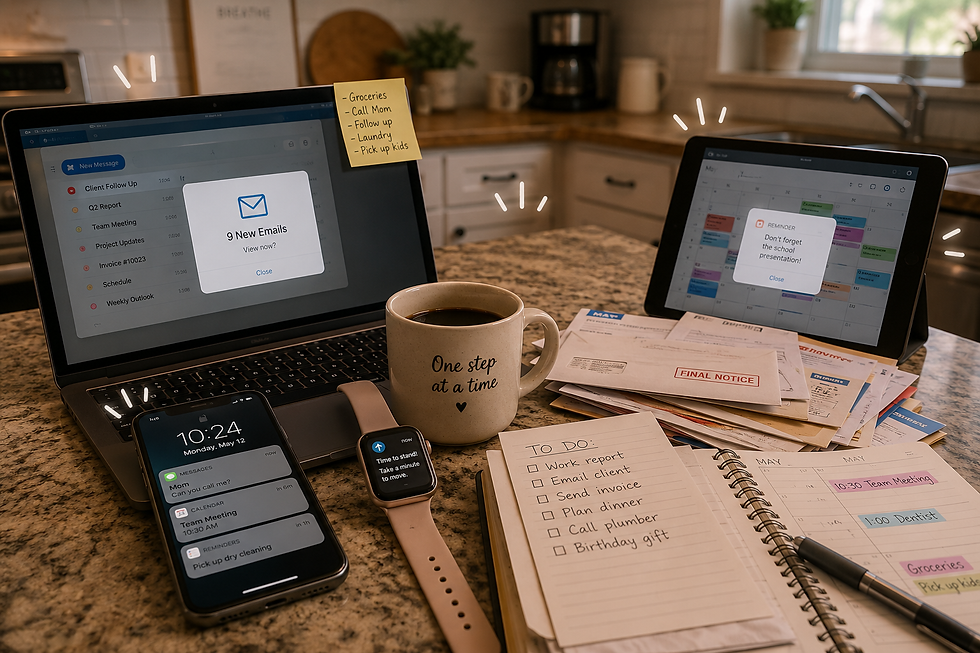
This becomes even harder in a world built around constant stimulation.
Phones.
Notifications.
Scrolling.
Multitasking.
Noise.
Endless information.
Constant input.
Most people rarely experience true mental quiet anymore.
And the brain adapts to that pace too.
Which means silence can suddenly feel:
boring
uncomfortable
agitating
emotionally loud
mentally restless
Not because you’re broken—
but because your nervous system has become used to constant stimulation.
When Productivity Becomes Self-Worth
For some people, productivity stops being just something they do.
It becomes tied to identity.
To usefulness.
To approval.
To safety.
And when that happens, rest can begin to feel emotionally threatening.
Because if your value has become connected to how much you accomplish…
slowing down may start to feel like failure.
Many people were also raised in environments where overworking was normalized.
Where slowing down was labeled lazy.
Where stress was treated as responsibility.
And over time, those messages quietly shape the way people relate to rest as adults.
This is why some people feel guilty resting even when they are exhausted.
Not because they want to suffer—
but because somewhere along the way, their brain learned:
“If I stop, I lose value.”
And that conditioning can run deeper than people realize.

Sometimes Rest Feels Unsafe
This is the part people don’t talk about enough.
For some people, being busy became protection.
Staying productive became control.
Staying distracted became coping.
And when life conditions you to stay mentally occupied all the time, quiet moments can suddenly bring everything to the surface.
Thoughts.
Emotions.
Stress.
Grief.
Loneliness.
Pressure.
Unprocessed overwhelm.
So instead of rest feeling calming…
it feels exposing.
Even these patterns often begin as protection.
Staying alert.
Staying productive.
Staying mentally busy.
Those responses may have helped you cope during stressful seasons of life.
The problem is that survival patterns can continue long after the environment changes.
👉 (If your thoughts tend to spiral once things get quiet, this may help → When Your Mind Spirals: What to Do When Everything Feels Like It’s Going Wrong)
Exhaustion Isn’t the Same as Rest
A lot of people think they rest regularly.
But what they actually do is collapse from exhaustion.
There’s a difference.
True rest restores the nervous system before burnout takes over.
Collapse happens when the body becomes so overwhelmed that it forces a shutdown.
That can look like:
doom scrolling while mentally exhausted
zoning out for hours
crashing into sleep after overextending yourself
feeling numb instead of restored
doing “nothing” while still internally stressed
And while collapse may temporarily stop the body…
it doesn’t always help it recover.

“Doing Nothing” Isn’t the Only Form of Rest
One of the biggest misunderstandings about rest is thinking it has to mean sitting completely still.
But rest can also look like:
cooking slowly without rushing
sitting outside for a few quiet minutes
stretching your body
working on something creative without pressure
listening to music while your mind settles
taking a walk without needing to “earn” it
allowing yourself to exist without optimizing every second
Because sometimes the safest way back into rest is through gentleness—not force.
The Body Keeps the Pattern
One of the hardest parts about nervous system conditioning is that the body can continue reacting to pressure even after life becomes calmer.
The pattern remains because the body learned it through repetition. Some people have lived this way for so long that constant tension actually feels normal.
They may not even realize how activated their nervous system has become because it simply feels like everyday life.
Sometimes healing begins with recognizing that "normal" and "healthy" are not always the same thing.
And once you recognize the pattern, changing it can feel unfamiliar too.
Which means healing often feels uncomfortable at first too.
Slowing down may initially feel:
restless
guilty
unproductive
emotionally loud
unfamiliar
For some people, slowing down also brings fear.
Not always conscious fear—but fear underneath the surface.
Fear of losing momentum.
Fear of falling behind.
Fear of finally feeling everything they’ve been too busy to process.
Or fear that if they stop pushing themselves, they may never “start again.”
That doesn’t mean you’re failing.
It means your system is adjusting to something new.
Your Nervous System Can Learn Safety Too
The same way the body learned pressure…
it can also learn safety.
Not instantly.
Not perfectly.
But gradually, through repeated experiences.
Through moments where you:
pause without punishment
rest without guilt
slow down without danger
stop performing long enough to simply exist
The body adapts to what it practices.
And that means healing is possible too.

A Gentler Way to Start
Rest is not wasted time.
The nervous system was never designed for constant output without recovery.
Recovery supports emotional regulation, patience, focus, creativity, clarity, and energy.
Rest is not the opposite of growth. It’s part of what makes healthy growth possible.
You do not have to suddenly become someone who meditates in silence for an hour every morning.
You do not have to force yourself into perfect routines.
And you do not have to “master rest” overnight.
Sometimes it starts smaller than that.
A slower morning.
A deeper breath.
Ten quiet minutes without stimulation.
Letting yourself sit down before you’ve “earned” it.
Small moments that slowly teach your body:
You are allowed to stop.
The work will still be there tomorrow. But a healthier version of you will meet it.
Fox’s Take
If relaxing feels harder than it “should”…
there may be more going on beneath the surface than laziness or lack of discipline.
Sometimes the people who struggle to rest the most are the ones who’ve spent the longest carrying too much for too long.
People who learned to survive by staying useful.
By staying productive.
By staying mentally busy.
And while those patterns may have helped them keep going at one point…
eventually the body starts asking for something different.
Not more pressure.
Not more pushing.
But recovery.
Because healing doesn’t always begin with doing more.
Sometimes it begins with finally feeling safe enough to slow down.
This article is intended for educational and inspirational purposes and is designed to support personal growth and intentional living. It is not a substitute for professional medical, mental health, legal, or financial advice.
© 2026 The Inspired Fox. All rights reserved.


Comments