
Why Comparison Kills Creativity
Updated: Oct 7

It can happen so quickly that we barely notice it.
You see something someone else created—a photograph, a beautifully decorated room, a piece of art, a clever idea, a business, a garden, a handmade gift—and your first thought might be completely innocent:
That's really good.
Then maybe:
Why didn't I think of that?
And somewhere along the way, admiration quietly turns into something else.
I could never make something like that.
Mine doesn't look nearly as good.
They're so much more creative than I am.
Maybe I'm just not good at this.
Nothing actually happened to your creativity in those few seconds.
You didn't suddenly lose your ability.
Nobody evaluated your work or told you that you weren't talented enough.
But the story you started telling yourself changed.
And sometimes, that tiny internal shift is enough to change what happens next.
Maybe you alter your idea to make it more like theirs.
Maybe you become overly critical of something you were perfectly happy with five minutes ago.
Maybe you tuck your work away where nobody can see it.
Or maybe you don't make it at all.
That's one of the quieter ways comparison can interfere with creativity.
It doesn't always arrive as jealousy or some dramatic crisis of confidence.
Sometimes it begins with something as small as noticing what someone else did—and deciding their ability says something about yours.
Comparison Isn't the Enemy
Comparison gets a pretty bad reputation.
We're often told not to compare ourselves to other people, as though comparison itself is the problem.
But comparison isn't necessarily harmful.
In fact, we use it constantly.
Comparison helps us gauge where we are.
It gives us benchmarks.
It helps us notice differences, identify what we like, recognize what we don't know yet, and decide where we might want to improve.
You might look at someone's photography and think:
I really like how they used the light there.
You might read something beautifully written and wonder:
How did they make that transition feel so effortless?
You might see someone doing something you would like to accomplish and realize:
Okay. That's where I'd eventually like to be. Here's where I am now. What do I still need to learn?
There's nothing inherently destructive about any of that.
Comparison can give us information.
The trouble often begins with what we do with that information.
There's a significant difference between:
They're really good at this.
and:
They're really good at this, so I must not be.
One is an observation about someone else.
The other is a conclusion about you.
And we can make that jump without even realizing we've done it.

The Story We Tell Ourselves Matters
Imagine two people looking at the same incredible piece of artwork.
One thinks:
That's genius. I wonder how they did that.
The other thinks:
That's genius. Why can't I come up with anything like that?
They saw the same thing.
The difference is the story that followed.
And those don't even have to be two different people.
They could be you on two different days.
On a day when you're feeling confident, curious, and excited about what you're doing, someone else's success might inspire you.
That's amazing. I want to learn how to do that.
On a day when you're already questioning yourself, the exact same thing can land very differently.
Of course theirs is better.
Why am I even trying?
I'll never be that good.
The comparison didn't change.
What changed was the lens you were viewing it through.
How we're feeling, what we're already worried about, and what we're telling ourselves can influence how we interpret the information in front of us.
That's also why we tend to notice comparisons in areas where we already feel like we're lacking.
If you're insecure about your writing, you're probably going to notice the person whose words seem to flow effortlessly.
If you're struggling with photography, you'll notice the person whose pictures always seem perfectly composed.
If you're questioning whether you're creative enough, the person who appears to have brilliant idea after brilliant idea can feel like proof of everything you think you don't have.
But there's a problem with that kind of comparison.
We often compare our weakness to someone else's strength.
Maybe their execution is incredible, but coming up with original ideas is difficult for them.
Maybe you can generate ten ideas before breakfast but haven't developed the skills yet to execute them the way you imagine.
That doesn't necessarily make one person more creative.
It means you're looking at two different sets of strengths.
When we forget that, admiration can start feeling a lot like inadequacy.

We Usually See the End
Most of the time, we're comparing ourselves to the finished version.
We see the beautiful photograph.
We don't see the 47 pictures that didn't make the cut.
We see the successful business.
We don't see the years when hardly anyone knew it existed.
We see the painting hanging on the wall.
We don't see the early work tucked away in a closet.
We see the polished article.
We don't see the deleted paragraphs, rewritten openings, research, edits, abandoned ideas, and moments when the writer stared at the screen wondering where the whole thing was going.
We see the end.
And unless we intentionally stop to think about it, we usually don't consider everything that went into getting there.
Experience.
Practice.
Education.
Time.
Money.
Equipment.
Connections.
Support.
Opportunity.
Failed attempts.
Responsibilities.
Resources.
Luck.
All of those things can affect an outcome.
Yet we often put someone else's result on one side of an imaginary scale and ours on the other and decide they should weigh the same simply because they look comparable.
But two things can look similar without carrying the same weight.
Imagine comparing two objects that appear nearly identical.
Same shape.
Same size.
Same appearance.
Put one in each hand, though, and you immediately realize they're made from completely different materials.
That's often what we're doing when we compare ourselves to other people.
We compare the visible outcome while ignoring everything that gave it its weight.
Someone may have ten years of experience where you have one.
They may have professional training.
They may have more time available to practice.
They may have failed at the same thing a hundred times before creating the version you're now admiring.
That doesn't mean their accomplishment should be dismissed.
Their work may be genuinely exceptional.
It simply means their result doesn't automatically tell you anything about your potential.
And even when comparison does give us information, we still have to make sure we're reading that information correctly.
Comparison Isn't Always Accurate Information
A photograph with thousands of likes isn't necessarily a better photograph than one with twenty.
A writer with a huge audience isn't automatically a better writer than someone hardly anyone has discovered yet.
Something selling well doesn't necessarily mean it's the most creative option.
And something looking effortless doesn't mean it was effortless to create.
Sometimes we're comparing talent when the real difference is experience.
Sometimes we're comparing creativity when the difference is resources.
Sometimes we're comparing quality when we're actually looking at popularity.
Sometimes we're comparing two people who aren't even trying to accomplish the same thing.
That's why comparison needs context.
What exactly are you comparing?
Why are you comparing it?
What information does the comparison actually give you?
And what are you doing with that information once you have it?
Without context, they're better than me doesn't actually tell you very much.
The problem is that we now have more opportunities than ever to make those quick comparisons without stopping to ask any of those questions.

The Comparison Machine in Our Pockets
Humans have been comparing themselves to one another for a very long time.
Social media didn't invent comparison.
It amplified our opportunities to do it.
Within a few minutes, we can compare our appearance, home, career, relationships, hobbies, cooking, creativity, vacations, accomplishments, and lifestyle to people we may never meet.
And we're often comparing ordinary moments from our own lives to moments someone else specifically chose to show us.
Take something as simple as a photograph.
Someone takes a picture of themselves.
They look at it.
No. My smile looks weird.
Another.
I don't like that angle.
Another.
Why does my face look like that?
Ten, twenty, thirty photographs later, they're no longer simply taking a picture.
They're trying to create one that matches a standard they have in their head.
And somewhere along the way:
I don't like this picture
can become:
I don't look good in pictures.
Then:
I hate my smile.
The judgment moved from the photograph to the person.
That's the same leap we can make with creativity.
I don't like what I made.
becomes:
I'm not good at this.
And eventually:
I'm just not creative.
Those statements may feel connected, but they aren't the same thing.
One awkward drawing doesn't tell you whether you can become an artist.
One bad paragraph doesn't tell you whether you can write.
One idea that doesn't work doesn't tell you whether you're creative.
It tells you something about that attempt.
The story you attach to that information can determine what you do next.
And sometimes, even when we keep going, comparison finds another way to interfere.
It simply moves the finish line.

When the Goalposts Keep Moving
One of the strangest things about comparison is that you can be improving and still feel like you're falling behind.
You start learning something with a simple goal:
I want to get better at this.
So you practice.
Six months later, you're noticeably better.
But your reference point has changed.
The person you once thought was amazing doesn't seem quite as far ahead anymore.
Now you've discovered someone else whose work is even more advanced.
So that's who you compare yourself to.
Then you improve again.
And find someone else.
The goalpost moves.
If the only direction you ever look is ahead, you can travel an incredible distance and still convince yourself that you haven't gone anywhere.
There will almost always be someone who knows more, has practiced longer, has a larger audience, has achieved something you haven't, or simply does one particular thing better than you do.
If that person becomes the measurement of whether you're doing well, success can remain permanently out of reach.
Not because you aren't improving.
Because the definition of "good enough" keeps changing.
And sometimes comparison changes the entire goal.
Maybe you started painting because you enjoyed painting.
Then you saw someone selling their artwork.
Suddenly, selling a painting seemed like the measure of success.
Then you found an artist with a huge following.
Now an audience mattered.
Then someone announced a gallery show.
Now that looked like success.
At some point, it's worth asking:
Was that ever what you wanted?
Comparison can hand us goals we never consciously chose.
But perhaps the greatest loss happens when comparison doesn't simply change the goal.
It convinces us not to begin.

Creativity Can Die Before Anything Is Created
You get an idea.
For a moment, you're excited about it.
Then you look online.
And there it is.
Someone already did it.
Worse yet, they did it really well.
Suddenly:
Well, theirs is better than anything I could make.
Someone already thought of it.
What's the point now?
So you abandon the idea.
But their version was never going to be your version.
Give ten people the same basic idea and you'll likely end up with ten different results because creativity isn't just the idea itself.
It's also the person bringing it to life.
Their experiences.
Taste.
Humor.
Mistakes.
Preferences.
Skills.
Perspective.
Choices.
All of those things become part of what they create.
That's one of the reasons adults can slowly move away from creating in the first place. As we explored in Why Adults Stop Creating, creativity becomes harder to enjoy when everything we make starts feeling like it needs to be good, useful, impressive, or worthy of someone else's approval.
Comparison adds another requirement:
It needs to be as good as theirs.
But creativity needs room to develop before it can be evaluated.
You have to make the awkward version.
The version that doesn't quite work.
The version that teaches you something.
If every new idea has to compete with someone else's finished work before you're willing to try it, many of your ideas will never survive long enough to become anything.
And you'll never know what the fifth version would have looked like because comparison convinced you not to make the first.
Of course, that doesn't mean we should stop looking at what other people create.
Other people's work can be one of our greatest sources of learning.
The question is whether it expands our creativity—or begins replacing it.
When Inspiration Starts Replacing Your Voice
Writers read other writers.
Artists study art.
Musicians listen to music.
Designers study design.
Photographers look at photographs.
We learn partly by observing what other people have already discovered.
Influence is part of creativity.
But there's a difference between allowing something to influence your work and allowing it to replace your voice.
Someone else's work can become input:
What do I like about this?
How did they achieve that?
What could I experiment with?
Or it can become a template:
This is what mine should look like.
Slowly:
What do I want to make?
becomes:
What should I make?
That's where comparison can begin crowding out originality.
Your creative voice develops through making things, trying techniques, rejecting others, changing your mind, making mistakes, discovering what you like, and doing enough of it that patterns begin to emerge.
Comparison becomes dangerous when it convinces you to skip that process.
And sometimes we don't stop creating altogether.
We just stop enjoying it.
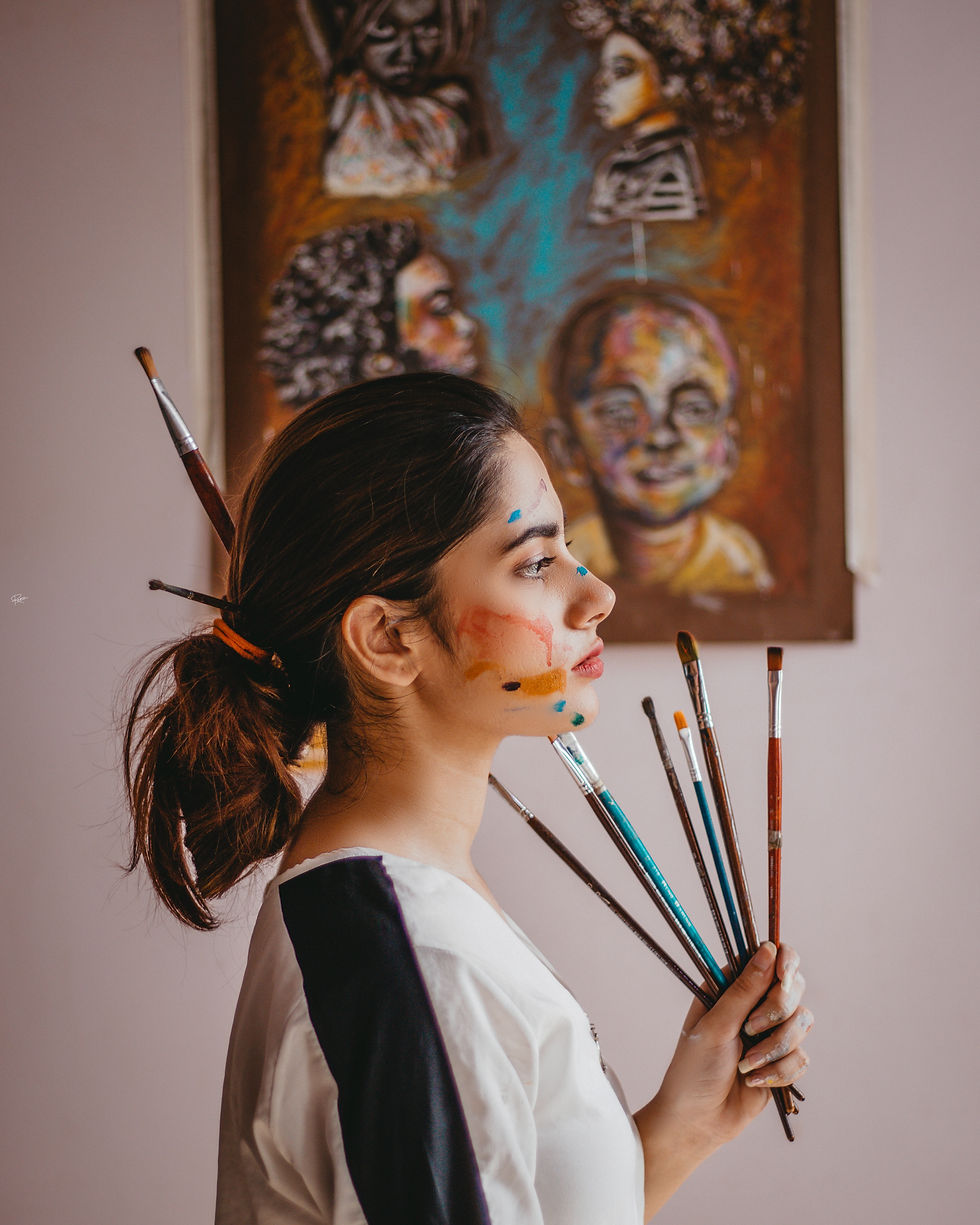
When "Good" Becomes More Important Than "I Enjoy This"
Maybe you loved taking photographs until you started noticing how much better other people's photographs looked.
Maybe you enjoyed baking until every cake started getting compared to perfectly decorated ones online.
Maybe you liked gardening until you decided your garden didn't measure up.
Something that used to be fun became something that needed to be good.
That's why it's worth remembering that Creativity Isn't Just for Artistic People.
Creativity shows up in the way we cook, decorate, solve problems, make gifts, arrange spaces, garden, dress, build, repair, and play.
And not everything creative needs to become something we're exceptionally good at.
Sometimes you are allowed to make something because making it feels good.
That's something we've explored in Making Something Is Good for the Soul. The value of creating isn't limited to the quality of the finished object.
Comparison can quietly turn participation into performance.
Instead of:
I love doing this.
We start asking:
Am I good at this?
You don't need to be an exceptional gardener to enjoy gardening.
You don't need to be a professional photographer to love taking pictures.
You don't need to sell your paintings for painting to be worthwhile.
There are things in life that are allowed to exist simply because you enjoy doing them.
And even replacing everyone else with a supposedly "fairer" comparison target—your past self—doesn't completely solve the problem.
Even Comparing Yourself to Yourself Needs Context
Comparing yourself to your past can be incredibly useful.
Six months ago I couldn't do this at all.
That gives you information about your progress.
But there is another version:
I used to make things all the time.
I used to have more ideas.
I used to be so much better at this.
Now you're competing with yourself from another season of your life.
Did you have the same responsibilities then?
The same amount of time?
The same resources?
The same priorities?
Even our own lives don't remain perfectly comparable.
Looking backward can help us understand where we've been.
It doesn't have to become another weapon we use against ourselves.
Which brings us back to the question underneath all of this:
If comparison is going to happen anyway, how do we use it without allowing it to define us?

How to Compare Without Losing Yourself
The answer probably isn't pretending we're never going to compare.
It's becoming more deliberate about what happens afterward.
When someone's work catches your attention, ask:
What exactly am I admiring?
Maybe it's their technique, confidence, attention to detail, use of color, simplicity, or the way they solved a particular problem.
Then:
What can I learn from this?
That question turns comparison toward growth rather than judgment.
If you're a beginner, this distinction becomes especially important.
Someone farther ahead can be a wonderful benchmark for what's possible.
They aren't necessarily a measurement of what you should already be able to do.
If they've practiced for ten years and you've practiced for ten weeks, I want to learn how to do that can give you direction.
I should already be able to do that can make the exact same comparison feel like failure.
Someone else's skill can show you where you might go without becoming proof that you're behind.
You can also ask:
Am I comparing things that are actually comparable?
Do I know enough about their journey to understand what I'm looking at?
Do I actually want what they have—or do I simply admire it?
And perhaps most importantly:
Am I using this information to learn, or am I using it to judge myself?
Research on social comparison suggests there isn't one inevitable outcome.
Upward comparisons can sometimes encourage self-improvement, but they can also contribute to negative self-evaluation or disengagement—particularly when the gap feels too large or the comparison is interpreted as evidence of inferiority.
In other words, comparison really can be information.
What matters is what happens next.
So take the useful information.
Leave the verdict behind.
Learn From the Work Without Becoming the Work
If someone else's creativity inspires you, study what caught your attention rather than simply reproducing the result.
Why does that photograph work?
What makes that paragraph powerful?
Why does that room feel welcoming?
What technique did they use?
Then take the principle, not the product.
If you love the warmth of someone's photograph, experiment with creating warmth in your own way.
If you admire the simplicity of someone's writing, experiment with removing unnecessary words from yours.
Look.
Learn.
Then close the tab and make something.
Give your own brain enough quiet to enter the conversation.
And make enough imperfect things to learn from them.
As we've talked about in Making a Mistake Is Not the Same as Being a Mistake, something going wrong can tell you what to change without telling you who you are.
This didn't work is information.
I can't do this is a verdict.
And sometimes one of the best ways to remember that distinction is to create something that doesn't need anyone else's verdict at all.

Protect the Part of Creativity That Doesn't Need to Perform
Keep something for yourself.
Not everything needs to be posted.
Not everything needs feedback.
Not everything needs to become a product.
Not everything needs to earn money.
Not everything needs an audience.
Not everything needs to be measured.
Make something nobody sees.
Write something you never publish.
Take photographs you don't post.
Bake the ugly cake.
Try the weird idea.
Create something with absolutely no intention of proving that you're good at creating.
Creativity needs places where it is allowed to play.
When everything we make immediately enters an environment where it can be liked, shared, ranked, purchased, praised, criticized, or compared, it's easy to forget what creating felt like before anyone else entered the room.
Sometimes you need to remember.
Because ultimately, none of us know what our creativity could become until we've given it enough time to develop.
Give Yourself Enough Time to Find Out
The hardest part about creativity may be that you don't get to know in advance what you're capable of becoming.
You have to find out.
And finding out takes time.
Practice.
Experimentation.
Bad ideas.
Good ideas that don't work.
Accidental discoveries.
Things you abandon halfway through.
Things you finish and don't like.
Things you make and love even though nobody else seems particularly impressed.
It takes making enough things that you begin recognizing yourself in them.
Imagine walking a long trail but stopping every few minutes to measure your progress against every person you encounter.
They're farther ahead.
They're walking faster.
They have better equipment.
They chose a different route.
They started before you.
Eventually, you could become so focused on everyone else's journey that you barely notice your own.
And perhaps you stop walking altogether.
That's the real danger of comparison.
It isn't simply that someone else's work might make you feel bad about yours.
It's that you might quit before you discover what yours could become.
You might abandon the hobby you would have grown to love.
The style you hadn't developed yet.
The idea you hadn't fully explored.
The skill that needed another year.
The business that needed more time.
The voice you hadn't quite found.
The version of you that could only exist after everything you hadn't learned yet.
You'll never know how good you truly can be if you keep stopping to compare yourself with everyone along the way.
And that's far too much potential to hand over to a comparison that may never have been fair in the first place.

Fox's Take
Someone else's creativity is not evidence that you lack it.
Admire people.
Learn from them.
Notice brilliant ideas.
Study beautiful work.
Let other people's creativity show you possibilities you hadn't considered.
Comparison can be useful information when you understand what you're looking at and what you're trying to learn from it.
Just be careful about the story you attach afterward.
Someone being farther along doesn't mean you're behind.
Someone doing something differently doesn't mean you're doing it wrong.
Someone creating something extraordinary doesn't mean there's less room for what you have to create.
Their path carries their experiences, resources, choices, mistakes, opportunities, and perspective.
Yours carries yours.
So learn what you can from the people around you.
Then return to your own work.
Make the thing.
Try the idea.
Take the picture.
Write the paragraph.
Bake the cake.
Pick up the paintbrush.
Be a beginner.
Be imperfect.
Change your mind.
Get better.
And give yourself enough time to discover who you might become when you stop asking whether you're as good as everyone else and start finding out how good you can be.
Sources & Further Reading
While this article is written in The Inspired Fox's voice, the ideas discussed are supported by research in psychology, social comparison, self-perception, creativity, and human behavior.
If you'd like to explore these concepts further, these are excellent places to begin:
Leon Festinger. A Theory of Social Comparison Processes. Human Relations, 1954.
Jerry P. Gerber, Ladd Wheeler, & Jerry Suls. A Social Comparison Theory Meta-Analysis 60+ Years On. Psychological Bulletin, 2018.
Erin A. Vogel, et al. When Every Day Is a High School Reunion: Social Media Comparisons and Self-Esteem. Journal of Personality and Social Psychology, 2020.
Adrian Meier & Benjamin K. Johnson. Social Comparison and Envy on Social Media: A Critical Review. Current Opinion in Psychology, 2022.
American Psychological Association (APA). Research and educational resources on social comparison, self-esteem, motivation, creativity, and human behavior.
Albert Bandura. Self-Efficacy: The Exercise of Control. W.H. Freeman, 1997.
Mihaly Csikszentmihalyi. Creativity: Flow and the Psychology of Discovery and Invention. HarperCollins, 1996.
Carol S. Dweck. Mindset: The New Psychology of Success. Random House, 2006.
National Institutes of Health (NIH) / PubMed. Research on social comparison, self-evaluation, motivation, self-esteem, creativity, and social media.
I’d love to hear from you.
Has comparison ever made you second-guess something you were creating—or stopped you from trying altogether?
If something in this article resonated with you, give it a like or share what stood out to you in the comments below. Your thoughts are always welcome here.
This article is for educational and inspirational purposes and is designed to support personal growth and intentional living. It is not a substitute for professional medical, mental health, legal, or financial advice.
© 2026 The Inspired Fox. All rights reserved. Interested in sharing our work, collaborating, or using our original materials? We’d love to hear from you—please contact us to discuss permission and appropriate use.


Comments